05
Word conversion.
.docx to XLIFF and back. Sentence-level segmentation that knows Dutch and English abbreviations, preserving bold, italic and underline, tables, lists, headers, footers and footnotes. The original document is embedded in the XLIFF, so the .xlf is all you need to rebuild, and auto-generated content — tables of contents, page numbers, cross-references — is excluded from translation. The space between sentences belongs to the document, not the translator: the rebuild puts it back the way Trados does, so a hand-typed target missing its trailing space can never fuse two sentences in the delivered file. Symbol-font content, the private-use characters Word uses for instrument readouts and Wingdings bullets, becomes an untouchable placeholder rather than unreadable text. A checkbox marks the first column of key-and-value tables as not for translation, so the left cell of every multi-cell row comes back untouched while everything else is translated as usual. Several files convert in one go: pick the job, enter the language pair once, choose a folder, and every document lands there as an XLIFF ready to be one LinguaTrans project. Dropping the translated XLIFFs back on the app converts them all in one pass, Word, PowerPoint, Excel and subtitle files alike, each returning under its original name. A failed file is named in the summary and stops nothing else, and a batch never overwrites what is already in the folder.
06
PowerPoint conversion.
.pptx to XLIFF and back. Slides in show order with their speaker notes, text boxes, placeholders, tables and grouped shapes, formatting kept on the runs that had it, and slide-number and date fields left untouched. The deck is embedded in the XLIFF, so the .xlf is all you need to rebuild it. SmartArt, charts and comments are left exactly as they are.
07
Excel conversion.
.xlsx to XLIFF and back, cell by cell, with a shared string used in many cells translated once and applied everywhere. Numbers, dates, formulas and booleans are left alone. Revision mode handles two-column sheets: pick the source and translation columns and each row becomes a segment with the existing translation pre-filled and unconfirmed, so reviewing is confirming and progress shows how much has been reviewed. Rebuild writes back into the translation column only, in-cell bold and italic runs included.
08
Subtitle conversion.
.srt to XLIFF and back, one cue per segment, with the line breaks inside a cue carried as tags rather than raw newlines so they survive the round trip and cannot be lost by accident. Timings and cue numbering are never touched, so the rebuilt .srt drops straight back into the video workflow. Pairs with LinguaTrans's per-line character limits.
09
XML conversion.
Prepare tbwint.xml for translation, and merge the translated XLIFF back into the original XML.
10
Trados packages.
Unpack .sdlppx without Trados installed: sdlxliff files extracted, embedded TMs converted to TMX, the integrated termbase exported. Repack builds the .sdlrpx return package from your translated files. Packages with inline locked content convert and round-trip like any other, so these jobs no longer need Trados at all. The whole round trip, step by step →
11
memoQ packages.
Unpack .mqxlz to its bilingual mqxliff, renamed after the package so it stays identifiable in a file list. Repack rebuilds the delivery from the original, swapping in only the translated file so the skeleton and everything else the client sent travels back untouched. Reports the language pair and segment counts on unpack, and points out when every segment arrived confirmed, the sign of a review or post-editing job.
12
Wordfast packages.
Unpack .glp to the TXLF files inside it, and repack the return package from your translated ones, without Wordfast installed. The same round trip as the Trados and memoQ modes, so a Wordfast job arrives as just another folder of bilingual files as far as the rest of the suite is concerned.
13
TM to TMX.
Convert Trados .sdltm translation memories to standard TMX for use in any CAT tool.
14
TMX merge.
Merge multiple TMX files into one, with translation-unit counting per file and skipped files reported.
15 — TM Variant Split
One TM, three Englishes.
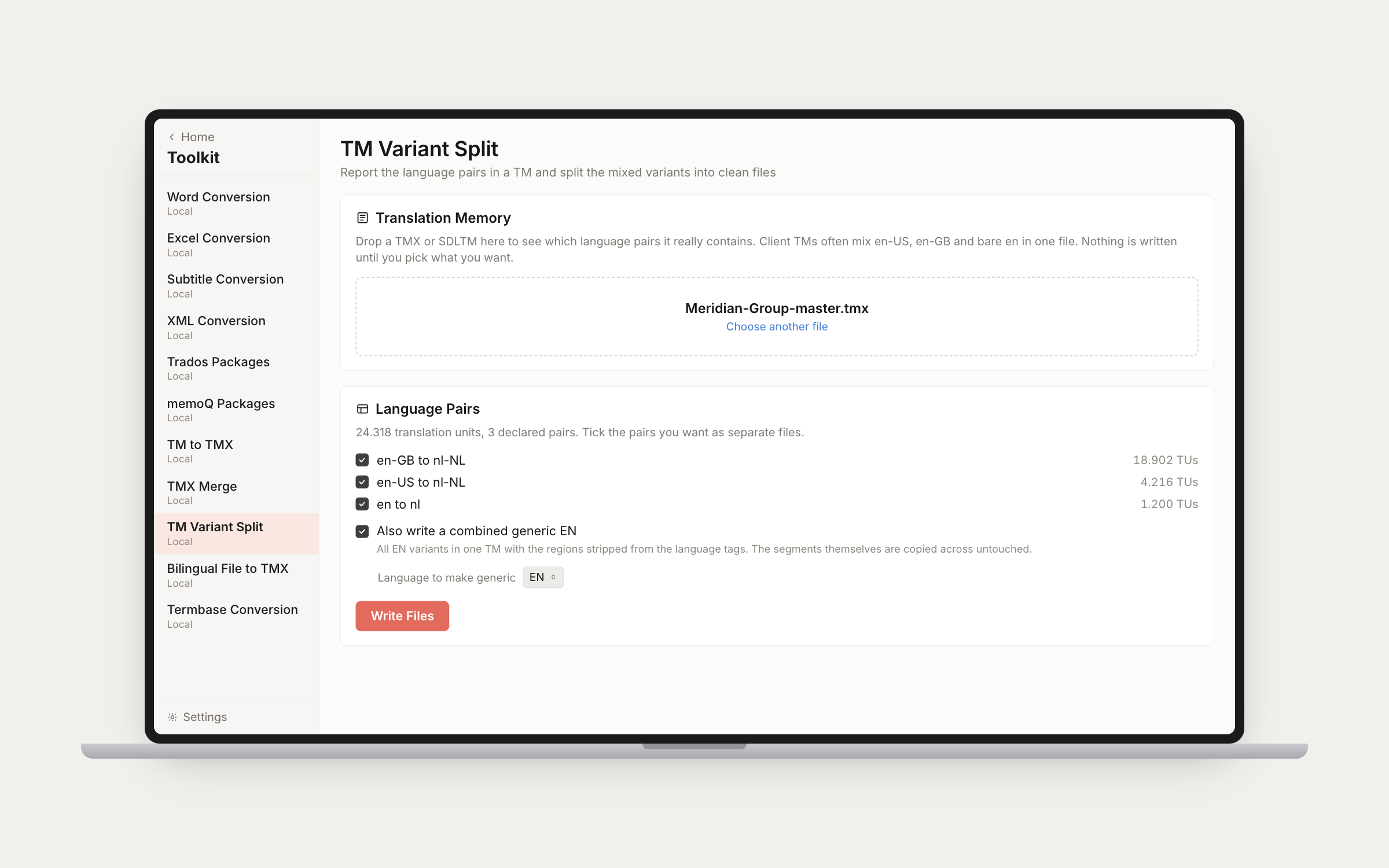
Client TMs routinely mix en-US, en-GB and bare en in one file. The first pass only looks: it lists every declared pair with its unit count, so you can see the shape of a TM before deciding anything, and nothing is written until you tick the pairs you want. The second pass writes one TMX per ticked pair with every translation unit copied out verbatim — inline tags, entities, formatting, whitespace, creation dates and user IDs all arrive exactly as they left, and only the header and the language tags are rewritten. It can also write a combined generic file, all the variants of one language merged with the regions stripped from the tags, which is what you want when a project is set up as generic EN because the client's TM is a mess. Deliberately narrow: no deduplication, no pruning, no tag stripping. It fixes language variants and nothing else.
16
Flip a TM. Beta
Turn a memory round so the target becomes the source, for a job in the other direction. Drop a TMX or SDLTM and the first pass only reports: units, the pair, the context properties that will go (after a flip they describe neighbours in the wrong language), exact duplicates merged, and sources that end up with more than one target. Flip then writes one TMX with every unit copied as it is, the new source first. A memory with several targets per source goes through TM Variant Split first. In TestFlight now, in the next App Store version.
17
Bilingual file to TMX.
Build a translation memory from any two-column bilingual file: a spreadsheet, a CSV or a tab-delimited glossary. The first rows are shown with the chosen source and target columns marked before anything is written, so a mispaired column or a header row turned into a translation unit is caught on screen rather than discovered months later as a confident wrong match. Columns, rows to skip and the language pair are read from the file's own header, and every one of those is yours to override. Reads semicolon CSVs from continental Excel, quoted fields containing commas and line breaks, and UTF-16 files saved out of Excel as Unicode Text. Empty pairs are skipped and identical pairs merged, both reported; one source with two different targets keeps both, the way a real TM does.
18
Termbase conversion.
Convert .tbx and .sdltb termbases to CSV plus a two-column glossary TXT ready for import into LinguaTrans or Wordfast. Synonyms come along: a concept with several sanctioned terms produces a row for each. Term status survives the conversion, with approved, preferred and rejected verdicts shown as filterable badges and carried into the exports as a Status column. A rejected term is a known-forbidden word, and the export now says so instead of presenting it as one more valid option. Auto-detects language pairs.